IRSA-Logo

The objectives of the Association are to: foster the development of rural sociology; further the application of sociological inquiry to the improvement of the quality of rural life; and provide a mechanism whereby rural sociologists can generate dialogue and useful exchange.

Recent history of the IRSA

Over the past decades, IRSA has continued to strengthen its role as an international forum for researchers, practitioners, and organizations working in remote sensing and related disciplines. Through its regular congresses, the association has provided a platform for scientific exchange, collaboration, and the dissemination of new knowledge, while adapting to technological developments and emerging global challenges.

The history of IRSA is reflected both in its congresses, which have brought together the international community at different locations around the world, and in the succession of presidents who have guided the association’s activities and strategic development. Each congress has marked an important milestone in the growth of the organization, while each president has contributed to maintaining and expanding IRSA’s scientific and professional impact.

The following overview presents the most recent IRSA congresses and the presidents who have served the association during this period. Together, they illustrate the continuity of leadership and the sustained commitment of the IRSA community to advancing remote sensing research and international cooperation.

Recent IRSA Congresses

2022 Cairns (postponed)
2016 Toronto
2012 Lisbon
2008 Goyang
2004 Trondheim
2000 Rio di Janeiro
1996 Bucharest
1992 Pennsylvania
1988 Bologna
1984 Manilla

Recent IRSA Presidents

2022-2026 Sally Shortall (Ireland)
2016-2022 Koichi Ikegami (Japan)
2012-2016 Geoffrey Lawrence (Australia)
2008-2012 Reidar Almås (Norway)
2004-2008 Alessandro Bonanno (USA)
2000-2004 Frank Vanclay (Australia)
1996-2000 Joseph Molnar (USA)
1993-1996 Andreas Bodenstedt (Germany)
1992-1993 Ken Wilkonson (USA)
1988-1992 Giampaolo Catelli (Italy)
1984-1988 Harry Schwarzweller (USA)
1980-1984 Bruce R Crouch (Australia)
1976-1980 Glenn Fuguitt (USA)

IRSA Congress registration

Authors and presenters are kindly reminded that the final deadline for author/presenter registration is 12 June. Please note that abstracts without at least one registered author by this date will, unfortunately, need to be removed from the programme.
Several field trips are already fully booked, while others are approaching capacity. Early registration via the congress website is therefore strongly recommended to secure participation in the remaining excursions. Further information and registration details are available on the congress website.

Call for Chapters for edited volume: Rural Depopulation in Europe: Challenges, Resilience, and Opportunities for Revitalization

The main objective of this volume is to address a timely and pressing issue in contemporary academic and policy debates on rural development: the dynamics, drivers, and consequences of population decline in rural areas. By focusing on the factors influencing the intensity and spatial variability of depopulation, the book aims to provide a comprehensive analytical framework for understanding how this demographic challenge shapes rural societies and territories. It also seeks to critically examine and synthesise the social, economic, spatial, and political impacts of population decline, highlighting their implications for rural sustainability and cohesion.

The volume will be included in the Research in Rural Sociology and Development book series by Emerald Publishing, which is indexed in Scopus. The series publishes research at the forefront of rural sociology.

The full Call for Chapters with the deadline is available in the following link: https://www.emeraldgrouppublishing.com/calls-for-books/call-chapters-rural-depopulation-europe-challenges-resilience-and-opportunities

The editors invite abstracts of no more than 400 words on topics related to rural depopulation, along with short CVs of the chapter authors. Abstracts should be sent to both Editors: Apostolos G. Papadopoulos at apospapa@hua.gr and Maria Jesus Rivera at mariajesus.rivera@unavarra.es

Visiting Research Fellow

Apply for the Duke of Northumberland International Visiting Research Fellowship 2026
The Centre for Rural Economy (CRE) at Newcastle University invites applications for an International Visiting Research Fellow. The fellowship offers £6,000 to support travel, accommodation, and visas for a six-week visit (or two shorter visits) to collaborate with CRE staff on research activities. Fellows will engage with PhD students and deliver seminars. To apply, submit a CV (max 2 pages), cover letter (1 page), and a one-page outline of planned activity and CRE collaborator. See attached PDF for more information. Deadline March 20th 2026

Call for Working Groups for the XVI World Congress of Rural Sociology

This document provides detailed information about Working Group submissions to the World Congress of Rural Sociology. If you have questions that neither this document nor the Congress website can answer, please contact the member of the IRSA Scientific Committee from your region.

Important dates

  • April 30 to September 1, 2025: Submission of WG proposals on the Congress Website (extended deadline)
  • September 15, 2025: Publication of the list of selected Working Groups (WG)
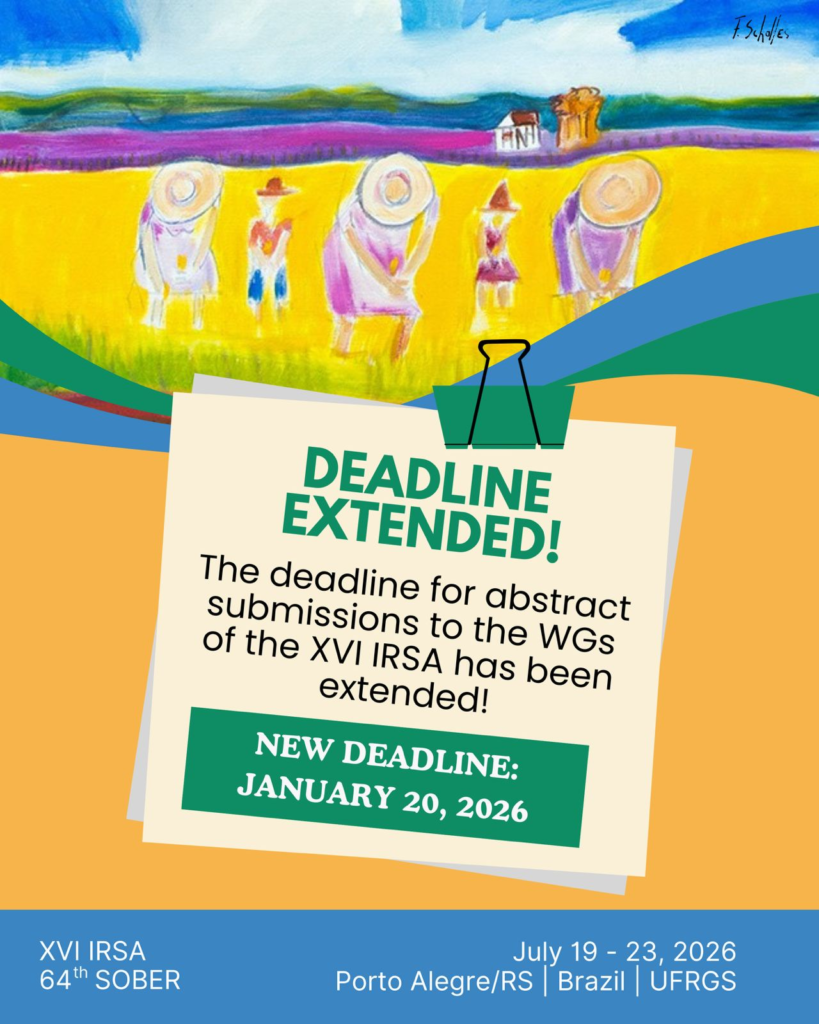
  • October 1 to December 18, 2025: Submission of abstracts to the selected WG
  • February 20, 2026: Selection of abstracts by WG Conveners
  • March 1, 2026: Publication of selected abstracts on the Congress Website

What is a working group?
A working group is a collaborative project organized by a team of 3 to 5 researchers from around the world to produce a high-value discussion on a topic of interest in rural sociology. The subject can be more general or specific and there is no minimum or maximum number of sessions. It will depend on the number of submitted abstracts. However, we will prioritize WG with at least 3 sessions (one per day) and encompassing subjects that are not too restrictive (except for very innovative areas) or too generalist.

Before the congress
The WG begins with a proposal written by 3 to 5 leaders who must have a PhD degree or have a consolidated trajectory in rural studies (not necessarily in sociology). The proposals will be reviewed by the IRSA Scientific Committee, who decide which WG can proceed to recruit abstracts.

The number of selected WG will depend on the available infrastructure and overlaps of subjects. IRSA Scientific Committee might suggest new thematic arrangements to avoid these overlaps or cover new subjects of interest for rural sociologists.

Authors must submit abstracts for the WG using the template available on the Congress website. WG conveners can ask the authors to share full papers before or after the Congress, but this must be optional and managed by the WG conveners themselves (ie. not using the Congress platform).

During the congress
All sessions will be in-person. No remote/online participation is planned.

The first session will include an introductory presentation in which the WG conveners will briefly introduce the main themes, objectives and questions.

Sessions must be coordinated by the WG conveners. They are also responsible for defining the format of presentations and discussions, as well as by controlling the time, inasmuch as the whole session does not use more time than previously defined by the congress organization.

WG can have sessions in English, Spanish or Portuguese, but not mixing these languages in the same session. In order that participants can identify the language of each session on the Congress Program, conveners have to decide which languages will be accepted by the WG. Considering the Congress take place in Latin America, in order to enlarge participation, we suggest that at least one of the conveners could also be able to evaluate abstracts and coordinate sessions in Portuguese or Spanish.

Formatting the proposal and practical organization plan
The list below summarizes the requirements for a Working Group proposal:

  • Title
  • Name of 3-5 coordinators with their affiliations and a short bio
  • Main goals of the WG
  • Subjects that will be discussed
  • Proposed methodology
  • Languages accepted in the WG (English, Portuguese, Spanish)

Criteria for selection

  • Relevance of the topic for current rural social studies.
  • Overlaps and complementarities with other propositions.
  • Diversity of WG proponents in terms of region, affiliation, and gender.
  • Previous experience of the WG conveners in the subject. Yet, we encourage WG to consider at least one early-career academic (PhD doctor for less than 5 years).

IRSA Scientific Committee


Announcing the XVI World Congress of Rural Sociology

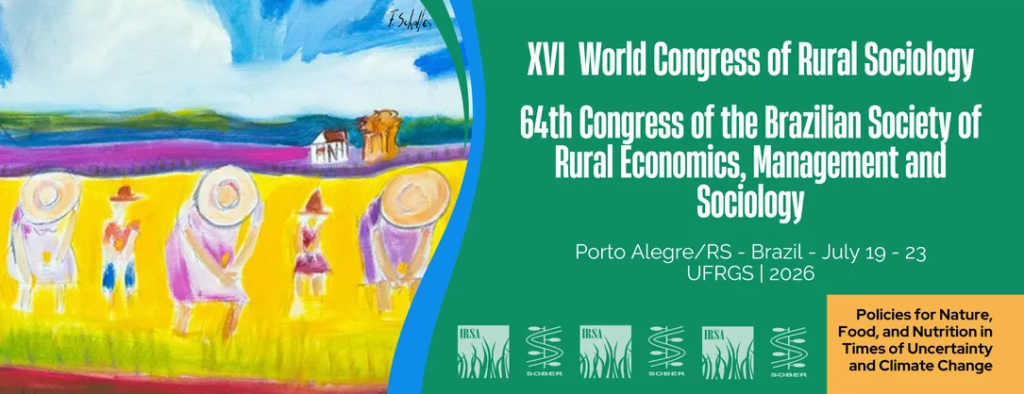
From July 19 to 23, 2026, the Brazilian Society of Rural Economics, Sociology, and Management (SOBER) will proudly host a joint congress featuring the XVI World Congress of Rural Sociology and the 64th Congress of the Brazilian Society of Rural Economics, Sociology and Management. The will take place at the Federal University of Rio Grande do Sul in the vibrant city of Porto Alegre, Brazil.

Call for abstracts for the 30th European Society for Rural Sociology Congress

Dr Rudi Messner, A/Professor Elizabeth Ransom and Prof Carol Richards invite abstracts for Working Group 9:  From Food country to Carbon country – Rural Livelihoods and the tensions between agriculture and ‘climate-solutions’ markets at the European Society for Rural Sociology (ESRS) – July 7-11, 2025, Riga, Latvia. For more information about the conference please see the ESRS2025 conference website and abstract submission site.